Sunday, May 15, 2011

The Three Men & the Kingdom: A Parable inspired by this morning's sermon

There once was a king who ruled over a vast, ever-expanding kingdom.  The borders of his kingdom were large and grew regularly as outlying territories gratefully accepted the king's lordship over their lands and his protection of their borders.  He was a good king, a benevolent king, and his kingdom spread through charity, not through conquest.

There were also three men who lived in a village in one of the outlying territories.  All of these men had heard of this benevolent king, but they each reacted to their knowledge of him in different ways.  The first man who knew of the king always spoke well of him.  He knew how the king loved his citizens and how he took care of their lands, so this man went around telling everyone in his outlying territory how good this king was.  This man could speak nothing but praise for the king, but when it came to the way he managed his own affairs he was anything but like the king.  He treated his family and his fellow villagers poorly; he mismanaged his meager wealth and land, selfishly hording all he had for himself and diminishing what little he had in the process.  He knew of the good king, and spoke well of him to everyone he met, yet he acted nothing like the king.

Then there was a second man who lived in this same outlying territory.  He also knew of the good king, but thought neither good nor ill about him.  He was indifferent toward this king, because he seemed distant.  The king was not the ruler of the man's territory, so he felt no need to acknowledge him in any way.  Nevertheless this man managed his affairs exactly the way the king had told the citizens of his own kingdom to manage them.  He cared for his family and for others, offering them free services of his trade, and giving to anyone who was in need.  He managed his meager wealth and his land well, seeing that all he had was used for the benefit of those around him.  He cared little for the good king, but he acted just as the king would in almost all things.

Then there was a third man who also lived in this outlying territory.  He knew of the good king, as well, and both spoke well of him and managed his affairs the way the king instructed his citizens to manage them.  Like the first man, he was constantly speaking well of the king to all those of his village.  Like the second man, he also managed his affairs in the way the king instructed the citizens of his kingdom to manage them.  He was just like the good king; he loved the king and his kingdom, and also ordered his life in a way that imitated the king.

One day, the good king's emissaries came to the outlying territory where the three men lived and announced to them that the good king was expanding his kingdom and rule into their territory.  This was good news because the territory had been threatened by various other clans and all knew that the good king could protect them from these threats.  The emissaries told the people of the outlying territory that they were free to leave the territory if they did not want to be ruled by the good king, and that there were only two stipulations for those who wanted to stay: first, they must acknowledge the absolute rule of the good king--they could pledge allegiance to no other; second, they must order their lives according to the law of the kingdom--the only law being that they must live as a servant to all their fellow citizens.

The first man heard this news and was very distraught.  While he spoke well of the king and had no difficulty pledging allegiance to him and his kingdom, he knew that his life would have to radically change in order to meet the second stipulation of citizenship--becoming a servant to all.  He almost turned away and chose to live outside the kingdom for this reason, but he eventually reluctantly chose to embrace citizenship in the new kingdom and strove to mend his ways.

The second man heard this news and received it with joy and only a little reluctance.  While he had never acknowledged the king before, and had some difficulty doing so now, as soon as he saw how the king's law encouraged him to live the kind of generous life he was already living, he quickly consented to acknowledging the king's rule over his lands.

The third man heard this news and received it with great joy.  The king he had loved and praised all his life was now lord over his lands, and the life the man had always lived was now acknowledged and encouraged by the kingdom's law of love.  He was the first man in the village to consent to the king's rule, and many followed his lead because of the sheer joy they saw in him.

Therefore, on the day when the kingdom fully subsumes our territory, it will be better for the man who lives like the King and does not praise Him than for the man who praises the King and does not live like Him.  Better still will it be for the one who both praises and lives like the King.

Tuesday, May 10, 2011

A Brief Review of Rob Bell's "Love Wins"

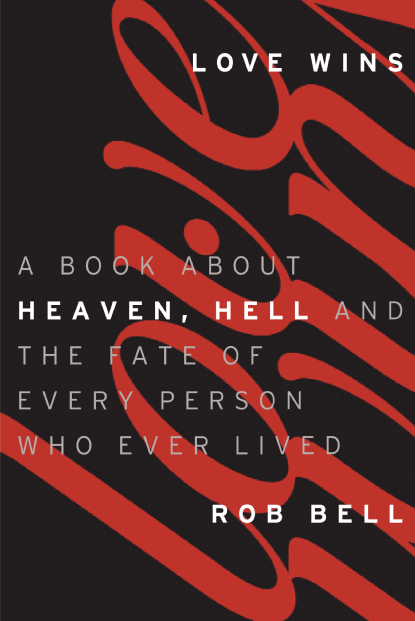
Well I recently read through Rob Bell's Love Wins: A Book about Heaven, Hell, and the Fate of Every Person Who Ever Lived--the most controversial Christian book for...err..probably the next two or three months (after which time we'll have something else to argue about).

It's stirred up more controversy and media attention that I think anyone anticipated, and yet, honestly, I thought that Bell has written more compelling stuff than this (anyone remember Velvet Elvis?).  As promised in this title, I'll try to keep this a brief review.  (Click HERE for another very helpful review from Relevant Magazine.)

Bell got lots of media attention as well as the stink eye from several conservative evangelicals for seeming to promote "universalism"--or what some mean by the term "universalism."  Basically Bell caused an uproar because, as some claim, he says that everyone will end up turning to God for salvation in the end.  Is this accusation valid, though?

The short answer is, "yes"; the longer answer is, "well, kinda."  The critical answer is: Bell is not very consistent with himself throughout even this one book.

This is my main critique: Although Bell is a thoughtful communicator, with a pastor's heart, and a love for the scriptures, he simply does not think very carefully.  He spends the majority of the book building a case that essentially says that, in the end--at the very ultimate end of all things--all people will finally desire to choose God and will thus be saved (which is at least one way of defining "universalism," though not the way I'm sure Bell would define it).  Then the very last brief chapter is all about a call for urgency in the present--today is the day of salvation!  ...or is it tomorrow?  ...two hundred years down the road?  ...a few millennia from now?  Bell is inconsistent here.  The vast majority of his book screams--though not always in so many words (he is an elusive writer)--'God will win us all back in the end!'  But the final appeal is: 'Accept the Gospel now!'  Bell ends his book by saying that "Jesus reminds us in a number of ways that it is vitally important we take our choices here and now as seriously as we possibly can because they matter more than we can begin to imagine." (p.197)  They do?  How much does my decision to reject Jesus now really matter if I know that in the end everyone is necessarily going to come to accept him?  At best this is simply naivete; at worst it is a very misleading notion about God's love and human freedom.  As Bell tries to affirm throughout his book, God grants us the freedom to reject him.  Bell wants to suggest, however, that none of us will reject him forever.  How truly meaningful is my acceptance or rejection of Christ (and how real is my freedom) now if in the end we all know that we're all going to accept him?  It seems to me like Bell recognized that you simply cannot get around the call to urgent repentance when considering Jesus' message--"Repent and believe the good news, for the kingdom of heaven is near!"  His whole book works against this urgent appeal, however, making the last chapter sound very forced and fake.  'It is urgent that you accept Christ,' says Bell, 'but if you don't, you'll get do-overs for the rest of eternity.'  What part of this message do you think will stick in the listener's ears?

A praise for Bell, then:  One very important pastoral and theological point that Bell makes throughout the book is stated clearly here: "To say it again, eternal life is less about a kind of time that starts when we die, and more about a quality and vitality of life lived now in connection to God." (p.59)  Bell wants to get away from the narrow definition of eternal life as "what we get when we die."  No, says Bell.  Eternal life is what Christ offers to us here and now, and it will extend throughout eternity.  But it begins now.  Well put!  This is much the point that I think C.S. Lewis's The Great Divorce (which, also to his credit, Bell cites at the end of the book, in the Further Reading section) was written to make.  As Bell says elsewhere, ultimately "we get what we want. . . .  If we want hell, if we want heaven, they are ours." (p.116, 118)  Heaven and hell are not simply two desinations: they are two ways of living that begin here and now and are embraced by each and every step we take in this life.  I can thoroughly affirm this.

On a different note, Bell tries to call the tradition of the church to his aid throughout the central 'argument' (if there is a central argument) of the book.  For instance, he writes: "In the third century the church fathers Clement of Alexandria and Origen affirmed reconciliation with all people.  In the fourth century, Gregory of Nyssa and Eusebius believed this as well.  In their day, Jerome claimed that 'most people,' Basil said the 'mass of men,' and Augustine acknowledged that 'very many' believed in the ultimate reconciliation of all people to God.  Central to their trust that all would be reconciled was the belief that untold masses of people suffering forever doesn't bring glory to God. . . .  To be clear, again, an untold number of serious disciples of Jesus across hundreds of years have assumed, affirmed, and trusted that no one can resist God's pursuit forever, because God's love will eventually melt even the hardest of hearts."  (p.107-108)  Bell attempts to paint a picture of a "wide stream" of orthodoxy embracing the basic stance he takes in his book--namely that no one will choose hell forever, and eventually God will win us all back.  This is simply not true.  Once again, Bell is at best naive here, and at worst ingenuous.  The fact of the matter is that none of the Church Fathers he has here mentioned (and mentioned only in the briefest of passing, without any citation whatsoever) would affirm Bell's stance in this book.  The notions that Bell is suggesting in this book are almost exclusively products of the modern era (the past 250 years or so), and while that should not cause us to dismiss Bell's argument, the fact of the matter is that he cannot call the "wide stream" of orthodoxy to his aid here.  Anyone who has taken an introductory course in historical theology could affirm as much.  Augustine and Rob Bell do not say the same thing--believe me.

Another praise for Bell, then.  At one point he comments: "[I]t is our responsibility to be extremely careful about making negative, decisive, lasting judgments about people's eternal destinies." (p.160)  I want to affirm this point and say that many of us have speculated in this area far too much.  Whenever we speak about the eternal destiny of a person, we usurp the judgment seat of Christ and attempt to place ourselves upon it.  Christians may certainly have a measure of certainty concerning their own ultimate salvation, and those who overtly reject Christ and his kingdom throughout their lives may certainly earn our disapproval, but to make final judgments about anyone's eternal destiny is idolatry.  We set ourselves on Christ's judgment seat when we do this, and in dethroning him we only call down judgment upon ourselves.  Let us never forget the simple words of Christ: "Judge not, lest ye be judged."  A huge warning to us disciples if ever there was one.

Finally, let me also say that while I have some significant reservations about this book, I am always thrilled to read Bell because I will always find an attempt to actively dialog with the scriptures.  This is my highest praise for Bell: he seriously wrestles with the Bible.  For this reason, I would be willing to dialog with him about anything.  If he wants to suggest universalism (or whatever he wants to call it)--fine, let's talk about it, so long as he is dedicated to remaining faithful to the scriptures.  I do not think that Bell is always the best interpreter of scripture (some of his Greek and Hebrew word studies in this book were really off the wall, in all honesty), but the fact that he still feels strongly about being in dialog with the scriptures is very encouraging to me.

I hope you'll take time to read the book when you get a chance; and I welcome a continued dialog about it in the comments section below.  Thanks!

Wednesday, May 4, 2011

Faith Comes By Hearing

Lately I've been listening to the scriptures on mp3 instead of reading them. . . There's something about not being in control of the text, not handling it, not going back and forth, but rather just letting it wash over you aurally that is powerful. I recommend it! These texts were meant to be heard at least as often as read. (Check out FaithComesByHearing.com for free audio Bible downloads in several translations.)
 You'll be surprised, too, how much scripture you can listen to in a short period of time.  Listening through the whole Bible in a year--or whatever timetable you may have embraced--would probably seem a much less daunting task than reading through it in the same amount of time.

Just a recommendation . . . .